
Transcript
Announcer:
Welcome to CME on ReachMD. This episode is part of our MinuteCE curriculum. Prior to beginning the activity, please be sure to review the faculty and commercial support disclosure statements as well as the learning objectives.
Dr. Lopes:
Hello, this is CME on ReachMD, and I'm Dr. Renato Lopes. And I'll be discussing with you today about real-world evidence setting the stage and pointing out the main differences between real-world evidence and randomized clinical trials.
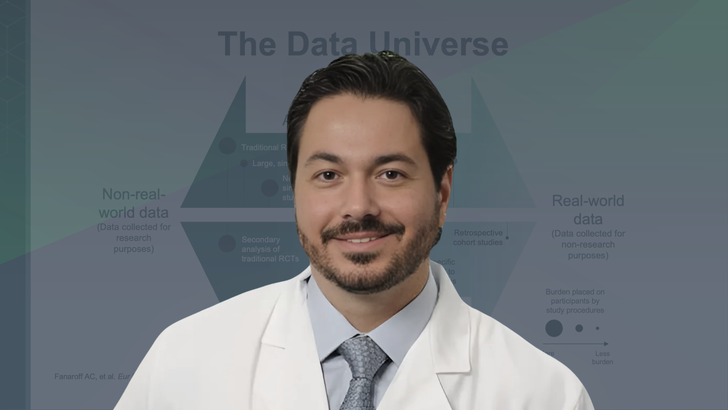
So it's important to realize that when we talk about data, there is actually a data universe where there are different types of studies and different study designs that can answer different types of questions. So in one hand, we have what we call the, really, non-real-world data, which has basically been coming from the traditional randomized clinical trials. Then, on the other side of the spectrum, we have what we call the real-world data, where basically the data is being collected for non-research purpose, but then we decided to do research with that data. So by nature, this type of data is always observational, whereas randomized trials are prospective and we always have an assignable intervention.
So with that in mind, you can always characterize or classify the type of study to closer to randomize trials or to be a randomized trial or closer to a real-world data type of study. In other words, how can we define real data? It’s really routinely collected data relating to patient health status and/or healthcare delivery. And every time we're going to be analyzing that data to potentially define benefits and/or risks of any medical product, that's what we call real-world evidence.
So, again, we can appreciate in this slide that we have different types of studies that are designed and well positioned to answer specific types of questions. It’s not about being right or wrong or being the best type of study; it’s about what is the question? So depending on my research question, I'm going to have better designs and different types of studies to answer that in a more appropriate way.
So in a nutshell, randomized trials, they are prospective, they have, obviously, randomization, which is the magic to make the 2 groups or the 3 groups, or how many groups we have in that study, balanced in terms of baseline characteristics. And because of that, we can assess causality in between the treatment and the effect. On the other hand, for real-world observational studies, they are observational in nature, they are non-randomized, and that's why we can’t always talk about associations between treatment and an effect. It’s very difficult to talk about causality when we don't have randomization.
So in summary, randomized clinical trials are still the gold standard for assessing treatment effects if we didn’t know if a drug or a device is better than another one. However, real-world evidence really complement the information that we have from the randomized trials. And remember, there is no perfect study. The important thing is to really define what is the recent question? And then understand what might be the best design to answer that question. There are strengths and limitations of real-world studies, and one needs to be fully aware of them before interpreting the results so we don’t run the risk of overstating results that the study might not allow us to do so.
Then, in the new era of clinical research, of being more pragmatic, the real-world evidence is becoming more and more important to really overcome the complexity around randomized clinical trials. It might really help in the evidence generation and regulatory process, together, in innovative designs such as, for example, the registry-based randomized trials where we can combine real-world type of data together with a randomization and maybe have a very innovative study design to answer clinical questions.
Thank you very much for listening.
Announcer:
You have been listening to CME on ReachMD. This activity is provided by TotalCME and is part of our MinuteCE curriculum. To receive your free CME credit, or to download this activity, go to ReachMD.com/CME. Thank you for listening.