
Transcript
Announcer:
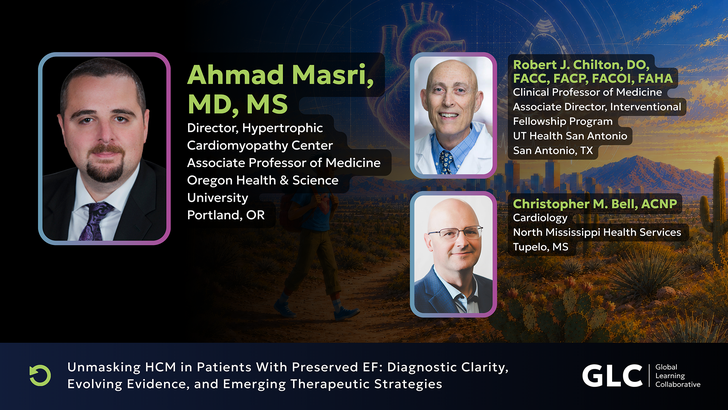
You’re listening to GLC on ReachMD. This activity, titled ‘Unmasking HCM in Patients with Preserved Ejection Fraction: Diagnostic Clarity, Evolving Evidence, and Emerging Therapeutic Strategies’ is provided by Global Learning Collaborative.
Prior to beginning the activity, please be sure to review the faculty and commercial support disclosure statements, as well as the learning objectives.
Chapter 1: Welcome
Dr. Masri:
My name is Ahmad Masri. I'm a cardiologist from Portland, Oregon, and I'm delighted to be joined by our esteemed faculty. Each one of them will introduce themselves. And our meeting today is titled Unmasking HCM in Patients With Preserved Ejection Fraction: Diagnostic Clarity, Evolving Evidence, and Emerging Therapeutic Strategies. If you've ever attended HCM talks or meetings before, this will be different. So we have some really good science to share with you.
These are our disclosures, and you can refer back to them.
Our learning objectives: apply a structured diagnostic approach to differentiate patients with HCM from HFpEF; discuss the evolving role of emerging therapeutic approaches, including SGLT inhibition in symptomatic obstructive and non-obstructive HCM; and evaluate the mechanistic differences between SGLT1 and 2 inhibitors.
So without further ado, Chris Bell will take us through HCM versus HFpEF.
Chapter 2:HCM vs HFpEF: Avoiding Common Diagnostic Pitfalls
Dr. Bell:
Thank you, Ahmad. Appreciate that. My name is Chris Bell from North Mississippi Medical Associates in North Mississippi, just south of Memphis. I'm tasked with trying to present a patient that's fairly common in how they present and help us appreciate how it's important to distinguish sites or the phenotype of their diastolic dysfunction.
So this was actually a 77-year-old African American female who presented to me because of a presurgical clearance issue. They observed a murmur in her case, and she had not seen a cardiologist in the past and otherwise had been relatively asymptomatic. No previous cardiovascular visits. Not in any distress. She had a longstanding history of hypertension, and she was on these 3 particular medicines for that: amlodipine, olmesartan/hydrochlorothiazide, and spironolactone. And the referral notes mentioned that she had ventricular hypertrophy and biatrial enlargement. But frankly, that was just from the EKG; there was no other assessment findings.
Upon presentation, we had already ordered an echo, and there had been some pre-existing labs. But she was independent. She told me that she was not very symptomatic, but actually she was. There were some things that she couldn't do exertionally because of shortness of breath, but still functionally quite independent. She denied any acute type symptoms with chest pain or palpitations or those sorts of things. In general, appeared to be fairly well in good health. Blood pressure was a little elevated. Pulse rate was 90. BMI was only 28. Labs were not very impressive. However, she did have a proBNP of 780. So, at this moment, when we had a little bit of a thick heart, or shortness of breath and proBNP, immediately I start thinking about a little bit possibility of preserved ejection fraction heart failure, even though it's not well defined.
And I guess the point here is we start thinking about a diagnosis even before we have all the data. So the echo was pending as I was talking to her in the room, and echo showed that she did have some LVH with a septum of 1.8, ejection fraction was preserved. There was some strain imaging that suggested a problem, and as you can see, in a 78-year-old African American female with apical sparing, I was a little concerned that we might be dealing with an infiltrative cardiomyopathy like amyloidosis, particularly Val142I.
But as we moved along and looked at the echo report, we noticed that there was a provoked gradient. We have tried to empower our sonographers if they see someone that appears to have a thick heart to go ahead and provoke them. It's amazing what sometimes they find even before we become aware of the potential of that diagnosis. And I'm thankful they did, because now I have to discriminate between preserved ejection fraction heart failure, whether this is an infiltrative cardiomyopathy, or whether this may be a sarcomeric problem with provoked gradients.
And I think that's the important thing. It's not enough to just look at this data; we have to early on try to put these patients in a silo. We cannot give them adequate treatment until we make the correct diagnosis. So we have the traditional forms of preserved ejection fraction heart failure associated with these comorbidities and those things that may mimic heart failure. Then we have the sarcomeric pathologies with HCM and obstructive HCM and infiltrative cardiomyopathies.
And in 2026, July of this year, in the Consensus Pathway Guidelines, we have this nice quote: HFpEF can present with overlapping symptoms, hemodynamics, or imaging findings. Failure to consider additional diagnosis may result in missed opportunities to institute effective therapies. And that's the purpose of our discussion is to really make sure we're making the correct diagnosis, and that way we can get them to the most effective therapy.
And certainly, in this case, we want to distinguish between HFpEF and HCM. I think probably don't have the time to go through all of these, but many ways the explanation of the etiology of the HCM to me is most important. What is driving that? Do they have malignant hypertension? Is there anything that could be driving that? Talking to them about their family history or any type genetic issues that might suggest sudden cardiac death may be helpful.
If we look at the 2024 kind of schema, as we have HCM and break that down, certainly an echo is the first choice because the easy availability. Most clinics have those. We certainly use that to kind of start the diagnostic pathway to kind of differentiate what we're dealing with. And then the advent of cardiac MRI has certainly been an asset over the last couple of decades, especially the last decade or 15 years, as we look at scar tissue and how that represents risk over time.
And then further, we differentiate the HCM from obstructive to non-obstructive, and looking at that gradient of >30. I mentioned earlier, we really try to encourage our sonographers, even in the absence of our request, if they see signals that look like it may be obstructive, to go ahead and provoke them. We can make the diagnosis after that if we have that data, and certainly that expedites us getting her on track.
So we saw this lady in April, and then by May we had made some changes. We stopped amlodipine. We instituted metoprolol, changed amlodipine to diltiazem, actually, and then we changed olmesartan/hydrochlorothiazide to a singular dose of olmesartan 20 because she did have hypertension. Her rate, it did improve. Her blood pressure improved, and most importantly, her Valsalva improved to 20 mm Hg. But we also, at this time, we've started to institute goal-directed Valsalvas, and it was still 70.
So my point in presenting this patient is I have someone who presents technically that could have fallen in any one of those 3 buckets. And it's not enough to just identify that someone has heart failure with preserved ejection fraction. We have to make the step to try to identify the phenotype. And there should be some kind of diagnostic pathway that you can do very quickly in your clinic to help get that patient to where they needed to be because we have effective treatments for each one of these. However, those treatments, if given to the wrong patient, can cause some problems, and certainly they're going to be poorly responsive.
Family implications: if it happened to be a genetic sequence, in her case, she did not have any genetic associations with some of the obstructive HCMs, or the arrhythmogenic issues, or amyloid. There was no history of sudden cardiac death, and that's always an incredible assessment that we need to make sure that we know. We may not have a second chance.
And the treatment options differ substantially. But therapeutically, they're very good with outcomes if we can get them to the right therapeutic option quickly, and that's what we're going to discuss a little bit later as we go through this program.
Thank you.
Dr. Masri:
Thank you, Chris, for taking us through this. As I was listening to you go through this case, the first thing that pops to mind is you have a 77/78-year-old black woman, and as if you're hinting that we should think about also transthyretin amyloidosis in that scenario, you know, which is really important because if someone has HCM and you do a genotype first approach, which many people nowadays are picking on, you actually can institute the wrong treatment. So we have seen many patients, black patients, who get a genotype first approach with TTR. They have LVH. They get V122I picked up on the genetic testing for TTR. They get told you have transthyretin amyloidosis. They get started on a transthyretin therapy when they don't need to.
So such a great case because it could be amyloid. Even with the LVOT gradient, on its own does not exclude amyloid. Just having an LVOT gradient, especially in women. And then aortic stenosis is another one that could come up, and that sometimes can, if you have tons of calcium, you might not sometimes be able to differentiate subvalvular obstruction from valvular obstruction.
So, and I'm very glad to hear that you do goal-directed Valsalva. For those in the room who don't know what that is, not doing Valsalva is one of the biggest problems in echo labs in the United States. We try not to repeat images, so we get images from everywhere for patients who are referred to us. And when 30% of these patients have no resting obstruction, they only have provoked obstruction. So the typical sonographer education, what they tell them to do is that you tell them take a deep breath, stop breathing, or blow it all the way out and stop breathing. But that actually misses most of these patients if they have no resting obstruction whatsoever. So with goal-directed Valsalva—and you can do it anywhere you live—nothing special, nothing fancy. You can get a syringe, or a straw if you don't have a syringe, but you should have a syringe, and they can essentially blow into the syringe, and you just pick your pictures. That actually brings you your gradient, similar to exercise. Exercise is nice because you learn more about their actual exercise capacity, but you don't want to exercise everybody, so you can do that in your own practice, and it will be really practice-changing when you do it. We've been doing it for 10 years, and it is practice changing.
Chapter 3:Unmet Needs and Emerging Evidence in Obstructive and Non-Obstructive HCM
Dr. Masri:
All right, so I'm going to talk about the unmet needs and emerging evidence in obstructive and non-obstructive HCM. So this is a controversial take that HCM still has unmet need. Even for the last 10-15 years, we keep hearing that HCM is not a problematic problem or disease anymore. That's because people look at mortality as the outcome. When you look at mortality in a disease that with modern therapy is no longer fatal over 5 to 10 years, everything is going to be great. There's not going to be a problem there, of course, because patients are not dying with modern therapy. But they have significant limitations with their exercise capacity, with their ability to do things in daily living, and that contributes to many things, including progressive metabolic syndrome, obesity, and other issues. But even when you look at registries like this is the SHaRe registry, even when you look at hard endpoints like survival, atrial fibrillation that is clinically significant, ventricular arrhythmias, ICD shocks, heart failure, it's actually still pretty substantial if you especially have earlier onset HCM. So if you get HCM by the age of 40, you have 80% cumulative incidence of a problem happening over the next 20 or so years. If you develop it by the age of 60, it's about 40%. It's pretty substantial.
And this problem is growing and growing. And we really don't know why it's a growing problem. One is recognition, so there is improved recognition, but the second piece of it is we don't know if our modern lifestyle, modern approach to living, is actually promoting the hypercontractility even in genotype-negative patients. Because think about it. What's the problem? The problem is that you're taking a heart, and you have all these risk factors that are contributing to developing HCM. But why does HCM happen? We don't know in the non-sarcomeric genotype positive patients. In 1/2 of them, these patients, or 3/4 of them, the response is reduction in ejection fraction and/or stiffness, and that's HFpEF. But in the 1/3 of them, what happens is, for whatever reason, the heart starts to work too much, and over the years, 5-10 years, it just loses its ability to self-regulate the input in that engine from how much gas you put in and how much brake system you have, and that's overactivity or overwork of the heart is the problem. That's how you end up with HCM.
Our traditional approach, if you look at the guidelines in 2020, was very primitive. You’d define them as obstructive and non-obstructive, 2/3 and 1/3. This actually is shifting to more 1/2 and 1/2 because of improved imaging, because of MRI, because of other things. And then you use beta blockers and calcium channel blockers. Then you can go to disopyramide and myectomy and alcohol septal ablation. And don't forget arrhythmia management and sudden cardiac death as Chris told us. But the funny thing here is that this is a first-line recommendation of a therapy that has no evidence actually behind recommending it. And so, but that is the traditional expert consensus on how to treat these patients.
So how did things change over the last 10 years? They changed by the introduction of this very important class of medications called cardiac myosin inhibitors. It took a long time to figure this out, but eventually it was figured that in hypertrophic cardiomyopathy, the hypercontractility is primarily driven by the sarcomere, which is the unit in the heart that promotes a lot of energy there and a lot of work, and it's the motor unit of the heart. But if you're sleeping, the heart shouldn't be working at 100% all the time with actin and myosin engaging; it should actually be about 60%-70%, and then when you go train for a marathon, you can engage more actin and myosin. But here you have a disordered state where you don't have enough interactions there.
So mavacamten was the first in-class cardiac myosin inhibitor, two phase 3 trials, EXPLORER and VALOR, showed that you can improve symptoms, exercise capacity in a randomized fashion, NYHA class, but cardiac biomarkers as well as avert the need for septal myectomy or alcohol septal ablation. And that won its FDA approval in 2022, and now it's approved in 5+ continents around the world.
But things emerged from mavacamten. Mavacamten has a specific pharmacology to it that makes it a little bit associated with some LV systolic dysfunction, some heart failure. And then in that clinical trial that we ran, which was EXPLORER, there was more monitoring than we have in the real world, and that translated to the FDA instituting this monitoring program called the REMS program, Risk [Evaluation and] Mitigation and Strategy program, where you cannot, for example, change the dose for 12 weeks; when you initiate it, you can only downtitrate. It's because of this issue that in the clinical trial, the way you monitored the drug was slightly different.
And then VALOR-HCM recruited a slightly different population but showed much more burden of adverse events from the drug. Really, the only adverse events that you have to think about are decreasing in ejection fraction, heart failure that could associate with that. Sometimes patients have dizziness upon initiation of the drug, and uncommon, but it happens, syncope can happen as well with the drug. So those are things you have to think about.
In the clinical trials, QTc have been, you know, observed over time, and checked over time, and there were some QTc prolongation. But in real practice, we don't see this as a problem necessarily. And then you have to make sure that you think about drug-drug interactions. Aficamten came with the phase 3 trial SEQUOIA, which is aficamten is the second in-class drug. It has improved pharmacology, shorter half-life, much less drug-drug interactions. Showed improvement in symptoms, in exercise capacity, cardiac biomarkers, LVOT gradients, and averting the need also for septal reduction therapies, improvement in KCCQ as well. And it showed that it has much less prevalence to cause this reduction in ejection fraction, as well as in causing heart failure in these patients with obstructive HCM. And so that won its FDA approval last year, and it allowed it to have a flexible REMS program. So the FDA still wants to keep an eye on these things, and so they gave that a REMS program that was much more flexible in how you titrate and do things.
This is just for you if you want to refer back to it in the future. There is actually a lot of differences between mavacamten and aficamten REMS program, but you know this is beyond the discussion of today.
MAPLE-HCM was a second phase 3 trial that randomized metoprolol against aficamten, and aficamten showed what you'd expect it to show, which is improvement in everything I mentioned already. But in the news that came out of this is that metoprolol, which we suspected in our clinical practice, is actually detrimental for these patients, was proven here to be detrimental. So metoprolol should not be a first-line therapy for the sole purpose of improving symptoms in exercise capacity in patients with HCM. It actually worsens exercise capacity. It worsens symptoms. It did not change LVOT gradients even at the maximum doses used in the trial. It worsened NT-proBNP and left atrial volume index. Not too many drugs cause you this much harm in a chronic outpatient disease where you're not going for survival necessarily. There is no survival data for beta blockers in HCM, so be mindful that you know beta blockers are not really good necessarily in this state.
Then you know the second wave after was to try and get through non-obstructive HCM, and so that's ODYSSEY-HCM, mavacamten in non-obstructive HCM, it did not show significant improvement in peak VO2, or KCCQ, or NYHA class. And maybe in the Q&A, if we want to discuss this, we can, but I don't want to spend too much time on it why the trial did not meet its endpoint. Mavacamten does work in non-obstructive HCM based on previous data and experience, but the problem is that its tolerability. You have 20%-25% of the patients who couldn't tolerate even in a clinical trial-driven program who couldn't tolerate the drug, and so that was the issue mainly probably.
In ACACIA-HCM, which we just reported last month—or now, yeah, in August, so almost a month and a half ago—showed that aficamten improved exercise capacity and peak VO2. And if you look at KCCQ with aficamten, it continued to progressively improve over time, while placebo fluctuates up and down. And the range of the improvement in KCCQ placebo corrected was anywhere between 3 and 7. And if you plot it over the whole duration of the treatment, it was about 5, 5 to 6 points there. And peak VO2 also improved on aficamten, and there was a whole slew of other secondary endpoints that also did improve.
Now, how does, then, this look like when you take all of this data and try to integrate it all together? So this how the future could look like. Do we need to wait for guidelines to change how we practice things? For things that are not approved, of course you need to. But for things that are approved, you don't need to wait for the guidelines because it just makes sense to move forward. One is what should be a first-line therapy in patients with obstructive symptomatic HCM? Now, payers might have different opinions, but really, right now, based on the trial, we have MAPLE-HCM, an upfront first-line therapy of aficamten, has been proven to be a better strategy. So you could think of this in the future.
Now, mavacamten, I'm keeping here in the in the second-line therapy group, because there was no trial of an upfront strategy of mavacamten in against metoprolol or beta blockers as a first-line therapy. Can it be a class effect? Sure, but that's up to you. We're trying to construct this as an evidence-based algorithm.
The second thing is aficamten now is proven based on a phase 3 trial ACACIA-HCM to actually improve exercise capacity and symptoms in non-obstructive HCM. However, we cannot use it yet. We need to get FDA approval for it, or if you live somewhere else, we need to get approvals for the use of aficamten in non-obstructive HCM.
Now that being said, non-obstructive and obstructive HCM have significantly complicated pathophysiology that underlie them, and the objective today is not to go over this. But the myosin/actin interaction is only one piece of it. You have abnormal structure and function. You have abnormal histological findings. You have abnormal vessels, abnormal perfusion. You have abnormal metabolism, fibrosis, profibrotic pathways, and energy utilization.
So if you look at that figure down here that I made for this talk, is that I think of this as 4 buckets. One is contractility modulation. One is energy, one is metabolism, and one is fibrosis. And so if you look at all we have now six phase 3 clinical trials in multicenter, reasonably sized trials in obstructive and non-obstructive HCM. So it can give you a lot of ideas about where are we? Yes, the drugs are good. Yes, we are improving how patients feel and function, but that's not universal. There is significant still unmet need beyond all of these things, and that's where that figure you know I showed you come into play. Because if you take a very complex disease, it's very hard to think that one strategy will meet the demands of all the patients, especially when you remember that our patients, 50% of them, have metabolic syndrome as well.
There is significant development activity that is happening in HCM. Those are the ones I'm listing here. They are not exhaustive. I just listed the ones that are at the clinical stage. There are so many preclinical activities happening in hypertrophic cardiomyopathy. So you have sotagliflozin, you have ninerafaxstat, EDG-7500, and then you have BHB-1893. Those 2 are actually going into phase 3 trials, and then you have phase 1 of WISPER modulation for fibrosis.
So just I want to spend few minutes on SGLT1 and 2 inhibition, which is with sotagliflozin. Sotagliflozin is now being conducted as part of the SONATA-HCM trial. It's a phase 3 trial of obstructive/non-obstructive HCM randomized to sotagliflozin versus placebo. And the first question that comes is why would you need SGLT1 and 2 inhibition in hypertrophic cardiomyopathy? If you actually go back, and Dr. Chilton will talk a lot more about this— if you go back to the basics of it, the heart has only SGLT1 receptors. It doesn't have SGLT2 receptors. And there are so many functions for SGLT1 receptors that in hypertrophic cardiomyopathy they're disorganized and dysregulated. That inhibiting that pathway could actually be beneficial.
I also left you a little bit of a small table in there that shows you that our current SGLT2 inhibitors that we use actually have really poor selectivity, and for SGLT1, the only one that has dual inhibition is sotagliflozin, and that's how it got promoted to this clinical trial that we're running right now.
There is a lot of now science coming out on this. So Sharlene Day and her group out of Penn conducted this study, which shows that acute exposure to SGLT inhibitors, sotagliflozin and empagliflozin, it reduced myocardial work and increased the potency of sotagliflozin at higher afterload compared to empagliflozin. So if you take myocardial slices and you subject them to afterload, if you use sotagliflozin or empagliflozin, you actually improve that situation. But sotagliflozin had a much better activity when you go to the higher afterloads, which is what we see in hypertrophic cardiomyopathy.
Finally, after 15 years of us using it day in and day out, we have a proposed mechanism for SGLT2 inhibitors in the heart, and this is a science paper from last month showing you that this pathway called PANK1 pathway, it promotes enzyme CoA to work more and improve the shift in the metabolism in the heart essentially in a favorable direction. So you can refer back to the paper that's showing how SGLT2 could actually work in the heart.
And then we have some data actually even on sotagliflozin. It's from the SCORED trial, which was a post hoc analysis looking at patients with left ventricular hypertrophy and no hypertension. This was a very, very sizeable program of sotagliflozin. And you can see here where there's improved outcomes over placebo in these patients, even hard outcomes with the use of sotagliflozin, even when they have LVH and no hypertension.
So key takeaways from me is that there is residual unmet need. Symptomatic obstructive HCM still has that unmet need, despite having cardiac myosin inhibitors. Now, some patients continue, even with the gradients gone, having experiencing some symptoms still. Hypercontractility is only one of the mechanisms in this complex disease, but it is one of the main mechanisms, and it's a primary driver of the disease process. That's why cardiac myosin inhibitors really changed how we treat these patients. But there is still that residual group of people that we need more work with.
Treatment is evolving, and patients with symptomatic non-obstructive HCM have no available therapeutic options to you to use tomorrow. As I showed you, the ACACIA-HCM trial was positive, but you can't go now—I mean, maybe you could off-label, but not at least based on all the label we have, you can't go now and prescribe the drug to patients.
And there are new pathways that are emerging, such as SGLT inhibition. I showed you 3 other pathways that could be targeted as well, and then multiple mechanisms most likely need to be addressed.
I actually think about this a lot. I think the future of HCM, especially those with non-obstructive HCM and those with obstructive HCM and residual symptoms on CMIs, I think the future is a combination of multiple therapies because you simply cannot address the complexity of this disease just by really targeting only sometimes one mechanism.
And with that, I'll turn it over to Dr. Chilton.
Chapter 4:HFpEF in Focus: Optimizing Cardiovascular Outcomes and QoL
Dr. Chilton:
Well, that was actually superb. I really enjoyed watching people take a look at these. We all look at the same things, but we have different outcomes and the way we come up with the actual assimilations.
This is a fascinating talk because I think most of you guys came and you're all in heart failure. Make sure they have elevated BNP because recently some of my house staff have missed it, and actually they said they had heart failure and the BNP is normal. I go, interesting. So let me take you through my side of it and at a basic science level.
Dr. DeFronzo has a fair amount of input in here, even though he's not named. The reason is, is because heart failure is metabolic. You want power, you're going to have to eat up some energy, and you're going to do that by getting good fuel sources. So even though I'm not going to talk about it, don't forget the heart really does need a lot of fuel.
There's 2 sides of it. This is a really simple slide. The top of it's the normal cardiomyocyte, and the other one is the guys that have the normal EF. So the EF is normal, but it doesn't do well. And one thing you can do, even—I don't know if my pointer will point down to it—but if you look down at the bottom, you can actually see where this is the normal calcium current that really generates really high-powered stuff. Look at this one; it's kind of not so good. Calcium is the thing that connects the actin-myosin fibers, so that gives you the power that you need. So 1/2 of that picture up there is a normal-looking cell, and the other side is not so normal. It's having trouble.
Now, most of you are familiar with the, I guess, fibrotic side because it's a normal ejection fraction and the heart just doesn't relax well. I had a gal, oh, I spent probably a couple weeks back, who’s 38 years old, quite overweight, short of breath, and I work in the interventional lab. We cathed her; her coronaries are normal. However, the question from the house staff, “Hey, you know we should give her some fluid and just see if her heart will stretch and see if she's stiff.” So normally, most of you guys here, and it looks like most of you are pretty good athletes and runners, your heart will stretch to 1,000 cc of fluid with no problem. I'll raise your wedge just a little bit. I gave her 300, and we called the code, and we put her on a ventilator. She was in pulmonary edema at a wedge of 40. That's stiff ventricle. That's really a preserved EF, but she can't relax well. Look at all that pink stuff on the slide. Those are humans, and they autopsied them, and you can see how stiff your ventricle can get. That's fibrotic. And interesting, as you saw previously in the previous talk, one of those slides goes down to the fibromyocyte and the production of stiffening.
So this is an example of one part of the heart failure story that you really got to keep in mind. So I'm going to cover through a little bit of each of these areas, but I'm going to cover on the last part the things that probably most of you are interested in.
The heart failure preserved EF actually is now being recognized more because you guys got echo machines. If you go back before that time, we didn't see it, but it was there, and it's been there for a long time. It's not new at all. We've known that people have very stiff ventricles. Most of the people that you see will have both a low ejection fraction with a pre- and post-stiff ventricle on both sides. You don't usually just have one thing, except for the HFpEF guys, and they do.
And we found that actually some of the reasons that you can improve that is there's a big protein, a spring that sets inside your cell that actually has receptors on there for SGLT2. It actually has SGLT1 on there, and it does when you give the heart failure stuff for 2 for sure, if you look at it, we got all great positive trials. We found that by accident, and that giant titin protein is a big deal for a lot of the things.
But the other part that no one talks about is inflammation and heart failure. Inflammation, if you have inflammation, your heart just doesn't squeeze well. You don't do metabolics well. You shift the different power curves as far as fuel to the heart. So you do need to check and see how inflamed they are. I wouldn't be surprised that all your drugs that you use for heart failure are pretty much anti-inflammatories, and they actually decrease the reactive oxygen species, so that the normal parts of the cell start functioning normal again. Although when you give the drug, we think it's this, but really, it's setting over here. We missed it. So keep your eyes open. You know this has not worked out completely at all.
On this slide, it shows you a fascinating one. Now we're going to go to human hearts. Most of you would have thought if SGLT2 works so good, how come it's not in the human heart? It's just not there. But one thing that was bizarre in these heart failure patients, there's all different kinds of them on the slide, every one of them, everything above that line is high. That's SGLT1. We didn't even know it was there. It makes you wonder. I mean, you're giving SGLT2, and you guys are improving and got an indication for heart failure, but the real action is sitting over here in 1. What the heck is that doing there? And so a few years ago, DeFronzo, myself, and other folks have been starting to look at what is 1 doing inside the myocardium that actually shows a protein expression.
This is a small slide, but it basically shows all the different talks, and the arrow down at the bottom is areas that we're working on currently on the SGLT2 expression and actually what goes on inside the cell. It's not just the actual stiffness; it's more than that. It's metabolic too, and so that's what we're trying to figure out. Why was it there? And why is it in some of the trials that people did with sotagliflozin, it actually showed a significant jump up in benefit? The 2 was for sure. We knew that already, but I don't know why you got so much more punch out of the other one.
So here's some of the remaining gaps. You already know the SGLT1 story. That's pretty good. The gaps remain. And why is it that in the actual sotagliflozin trial we had actually a reduction in infarctions? Why did we see a reduction in stroke? That's sort of more like the GLP-1 era. Why would that happen? So let me take you through a little bit what happens there. This takes a look at SGLT1, and what was found was that you have in the intestinal border you do have SGLT1, that ultimately to the bottom line is it shifts GLP-1. And GLP-1 has already been studied and actually has 3 big trials that all show reduction in stroke. So what we have is this compound that actually has the SGLT2 that works great in heart failure.
At the same time, it has another benefit that we just missed, and this shows up on the actual studies. So what is causing that is not real known. But I think one thing is clear: is that maybe it's TMAO, maybe long term we have trouble with a microbiome shift. Everybody just kind of focuses on one thing, but it's wider than that. All of you take care of patients; it's just not one thing.
If you look at the trajectory of heart failure, you notice that it gets worse as you get older, but so does the actual sudden increase in your blood pressure. All of you guys have normal blood pressure until you’re about 45. Then, without a boom, now I'm hypertensive. That trajectory shift's not known. I think we're still working on it, but it comes along at the exact same time. So does the obesity curves. They all fit about similar areas. There's a lot going on at one time, but SGLT1/2, the 1 is the one that most of us were really surprised about.
The other thing is the kidney is protected with the SGLT2. It helps a lot in that area. That's been studied a lot. However, the brain and the heart, the kidney and the intestine, all have sites for actual SGLT1, which we didn't see before. It actually has effects on the actual kidney itself, and certainly in the ischemic area.
And I'm going to take you down to the ischemic area towards the last. Here's the actual dual pathways you can see in the SGLT1/2 that you see with sota. You can change glucose absorption. Clearly, there's a direct tissue effect that you see. The GLP-1 was a surprise. Nobody knew that. You can see it symptomatically in your patients. Some of the patients will notice that when you give them the drug, and at the same time, it does have effects on natriuretic and metabolic effects. The metabolic effects haven't even been worked out yet. So it's a new compound, new area that I think you'll find most exciting.
Here's the actual areas that I particularly am interested in from the interventional side: myocardial infarctions and strokes. Missed it with the SGLT2s. All of our trials we missed. Could never get a positive. Why in the world does it not help a heart attack or a stroke, then comes along an SGLT1/2, and we reduce stroke. We have less heart attacks. How in the world can that be? Except that we didn't look at 1 very hard, and so now what we're finding is 1 potentially could have some significant areas that would protect not only in 2 but also in the SGLT2/1 area.
Now, here are 3 different panels here. One of them is the normal pathways with SGLT1 that he previously showed a little bit about. The other one is the actual acute ischemia pathway. In heart failure, you are targeting just the failure. In the cath lab where I work, we got to figure out what the heck is going on because if I don't figure out if it's ischemic, and I cath them and find high-grade disease, that would be important. Well, it affects that ischemic cascade. At the same time, in the actual chronic overactivation sequence, long term you will have effects that actually increase with fibrosis. So you got metabolic effects, you got fibrotic effects, and you have actually effects on GLP-1.
Now let's see. Here's the SCORED trial, which was interesting. Now, this SCORED trial, actually, if you look at the bottom line there, you can see the 2 different splits in that sotagliflozin and placebo. This is in patients with diabetes and chronic kidney disease. The interesting thing is the endpoint is quite positive. And all those authors on that paper, and the reason I put the paper on there, look at the guys' names on there. These are guys you all know. These are very well-known research guys, and they all really published this paper that shows us that it actually has nearly a quarter relative risk reduction.
This one takes a look at the very prespecified endpoints here on sotagliflozin when you look at the SOTA-P evidence, and here what we have is MI and stroke. And if you look at the SGLT2 arm, and you could put any drug up there, you pretty much want an SGLT2, and then you can see the infarct rate. Neither one of these really found a significant drop in MIs or strokes. Totally different area than what you were actually looking for. You're in heart failure, but I'm looking at MIs and strokes in the same type of a drug.
This takes a look at the actual P values on those when you actually break them out, and you can see MI and stroke are all significant in that area. So it's not from 2. We did all the trials on 2. We spent billions of dollars on that, couldn't ever find it, and I was very interested in looking at. I couldn't find it, but then you look at the SGLT1, it shows up.
Now, in closing, this is an interesting one. This just came out. If you want a hard test, you take sotagliflozin, and why don't you do a prospective, randomized, double-blind, but let's do an MRI scan. And in the MRI scan, you all would be looking at the pump function and maybe wall. What I'm looking at with the blue arrow is not that. I'm looking at fat. So is your adipocyte epicardially fat? Most of the people nowadays have plenty of extra fat around, and usually, if it becomes inflamed, you got problems. The fat itself produces more inflammatory signals than most anything in the body. So what we did here is we took a look, and you can see that there's a marked reduction in epicardial fat when you use this drug, and that's a well-done study with humans with MRI scans.
So how would that transmit? Since you're not quite familiar with epicardial fat, which you can see on echo, you can see it certainly on CT. Here we go. This shows you. I don't know why the music's on, but it will be there. If you look, that is the fat on top of the heart. If you guys could turn the music off, it would be easier for me to talk. Okay. That is a vein graft coming down, going into the myocardium, and the top of that is fat. Now, this is a skinny cowboy.
Now, when you go down and we have somebody that's a little less than skinny, it is hard to find a place. That is actually epicardial fat and that is active. And when we actually take LIMAs off and transplant them, we actually leave the fat on the vessel because we need some of the activity of that fat. Well, if it becomes inflamed, it's not so pretty.
So that gives you an idea of what we're dealing with. That's just like you, look into many of you guys use take and fix your chicken up for Christmas, you'll see the fat right on top of the heart. That's right on top of your coronary arteries.
So DeFronzo and I said 10 years ago we would take a look at taking samples for inflammation right where the lesion is in the coronary artery. And where is the fat? We took samples. They both matched. I'll show you to in a minute, but look at this one first, this is the mechanism behind it. This is monocyte chemoattractant protein-1. This is what goes like kind of like getting white blood cells to come over like pus on your skin when you cut it. Look at the fat around the heart on one side of the slide, and other side is your coronary artery. And if you look in the middle of the coronary artery right here, you can see the fat has macrophages underneath it, setting over here. This is active out here, just like is your actual fat in your belly. That active fat, once it turns on, actually have crosstalk. It's just interesting that the SGLT1 targets that and shrinks it. And it's also interesting, it is the one that is elevated in the guys that showed benefit in our trials. So I think it's an area of really something that's kind of fun and watch for.
Here's your local information from epicardial adipose tissue, and I think it's an area that all of us are going to look at. If I can reduce that fat. Now, if you lose weight and you take GLP-1, will you lose fat? Will you lose it around your heart? We already did those studies 2 decades ago, and CT shows the reduction. It comes off there first, although you think it comes off your belly first. Probably comes off your coronaries first. That fat is very active, and here is a drug that hits that target area that had not been seen.
This is one of my patients, and if you look, there's a blockage, and I'll try to show it to each of you. But if you look in the middle of the coronary, right there, you see that block. At the same time, you pull epicardial fat tissue from that area. It's activated and it has elevated levels of CCR. So I think it's one that we need to watch for. And this is one of the few compounds that hits that area.
If you think that, oh, maybe that's only 1 or 2 studies, it's not. Take a look at this. It's got all these trials. All the inflammatory signals are up, and this is Framingham data that we've used for years. You just kind of didn't see that because you were looking in heart failure, but we're looking over the metabolic side, trying to decrease inflammation. So there's more to it than just taking a look at just the heart failure, it's a lot deeper than that.
So, in closing, a couple of interesting comments. Again, the actual congestive heart failure domain, SGLT2, is alive and well. Clearly, that drug helps decrease heart failure. The area that's new is the ischemic domain. SGLT1 may be in this domain that we hadn't seen before because we weren't looking in the right place. Many of us work in different areas and facets. I don't normally come to this meeting. I'm in basic science and I'm over in the interventional side, but you are hitting my areas of people that actually have ischemic hearts and are having trouble. Quality of life is clearly improved in these trials.
So in the last 4 points, this basically kind of walks through each of the things that all of us talked about. SGLT2, great, absolutely no question decreases heart failure, and it helps. And it's simple to take, easy to take. But the area that was not seen before was the upregulation in the actual tissue of SGLT1. That's not even found in anywhere but in the heart, pretty much. For that part, it does affect the gut with GLP-1. So now is GLP-1 another player that we didn't see? But that is SGLT1 part. And I have a paper coming out specifically on just SGLT1 because there's a lot of basic science we just didn't see.
Thank you very much, and I'll turn it back to the moderator.
Chapter 5: Questions and Answers
Dr. Masri:
All right. I hope that you're all like me. I'm much more confident now with thinking about SGLT1 and 2. It's a topic that 3-4 years ago we really have not spoken much about.
I have a question for Chris. Chris, with these patients where you practice, do you feel that over the last 5 to 7 years things have really improved in the sense of trying to figure out why someone has HFpEF? Or how do you think things are shifting and moving in clinical practice?
Dr. Bell:
So, absolutely, they've improved. Absolutely. I mean, our capture rate in a small rural area in North Mississippi, we have over 160 people that we've recently diagnosed with infiltrative cardiomyopathy like amyloid, and some 150-160 with obstructive HCM. So certainly, we have improved.
I think the bigger question is how much further can we go? Because we're really just scratching the surface, and that's one reason we try to make it a system that we involve even the sonographers. I think they're an untapped resource to identify those patients that sometimes we send them for an echo based on a symptom, but they're seeing something structurally that looks a little bit different than what we expected, and we tell them to go ahead and evaluate that, so that we have that information and we can make the diagnosis sometimes after the fact. And I think that's helped us out a great deal.
Dr. Masri:
Great, that's an important message. Actually, working with the echo lab or your echo practice really, really, really can deliver a lot on this for differentiation of what's going on.
We have a question about if metoprolol beta blockers have a negative impact on exercise capacity. Do you see the guideline changing with MAPLE-HCM? Maybe not using beta blockers at all. I have my own opinion. I don't know if anyone would like to chime in about this. The guidelines are the guidelines.
Dr. Bell:
Yeah, the guidelines on metoprolol are pretty scant. I mean, that was what a 6- or 8-patient trial like 40 years ago. It was pretty small.
I do think it's important. Sometimes the reason I used that example this morning is that patient was on vasodilators and a diuretic. And if we can take a patient who we think has a provoked gradient off of offending medicines and control their rate and their symptoms improve and their gradient improves, not just the gradient—I don't treat a gradient, I treat a patient—then I think it's very reasonable to try. But most of the time, if I see that rate getting slow, and it becomes intolerable, we can't just say the gradient improved and the patient feels awful, and that's the dilemma. I think to put it in 1 bucket may be too simple.
Dr. Masri:
And changing culture is difficult. It will take time. It will take effort. Changing the guidelines can also be difficult, but the guidelines, again, they should follow the evidence. And if they follow the evidence, even if it's one phase 3 trial, the evidence right now tells you there is harm, and you should never harm your patient. And that's my opinion. And so we've actually, for 7 years, 8 years now, we don't use beta blockers for the sole purpose of improving symptoms in HCM, and if the payers make us use them, we use 25 mg of metoprolol succinate and stay at that. And so that's what we've been doing for a while. I'm hopeful that the guidelines, though, will change because the guidelines are right now being used against us when we're trying to do things. Dr. Chilton?
Dr. Chilton:
I think you have to be a smart doc and pick what is the best thing for this patient. If you tell me, it's like you're presenting the guy who’s short of breath, and like you do clinical medicine where you talk to the patient, the beta blocker does protect that overload of calcium for the sarcomere.
Dr. Masri:
So I think this is the key point, which is the patient in front of you, the indication in front of you, and remember the mediator of badness of beta blockers in HFpEF in HCM has to do with the LV end-systolic volume. When you have a tiny LV end-systolic volume and you throw a beta blocker in there to slow them down, that really causes issues. And based on MAPLE, that even increases your diastolic wall stress, which we really don't want.
Dr. Chilton:
And your stroke volume is down so much with somebody that's got HCM, you have to be careful. No, I mean it's a really important point. Your body needs actually the blood supply and oxygen, but you're going to have to watch what kind of patient you pick. Judgment.
Dr. Masri:
Great. We're out of time. I want to thank you all for being here with us today. I want to thank GLC for getting us all in this room and our esteemed faculty. Thank you.
Announcer:
You have been listening to GLC on ReachMD. This activity is provided by Global Learning Collaborative.
To receive your free CE credit or to download this activity, visit ReachMD.com/CME. Thank you for listening.

 Global Learning Collaborative (GLC) has been authorized by the American Academy of Physician Associates (AAPA) to award AAPA Category 1 CME credit for activities planned in accordance with AAPA CME Criteria. This activity is designated for 1.00 AAPA Category 1 CME credit(s). PAs should claim only the credit commensurate with the extent of their participation in the activity.
 Global Learning Collaborative (GLC) designates this activity for a maximum of 1.00 contact hour(s)/ 0.10 CEUs of pharmacy continuing education credit.


