
Transcript
Announcer:
You’re listening to Heart Matters on ReachMD. This episode is sponsored by CSL Behring. And now, here’s your host, Dr. Brian McDonough.
Dr. McDonough:
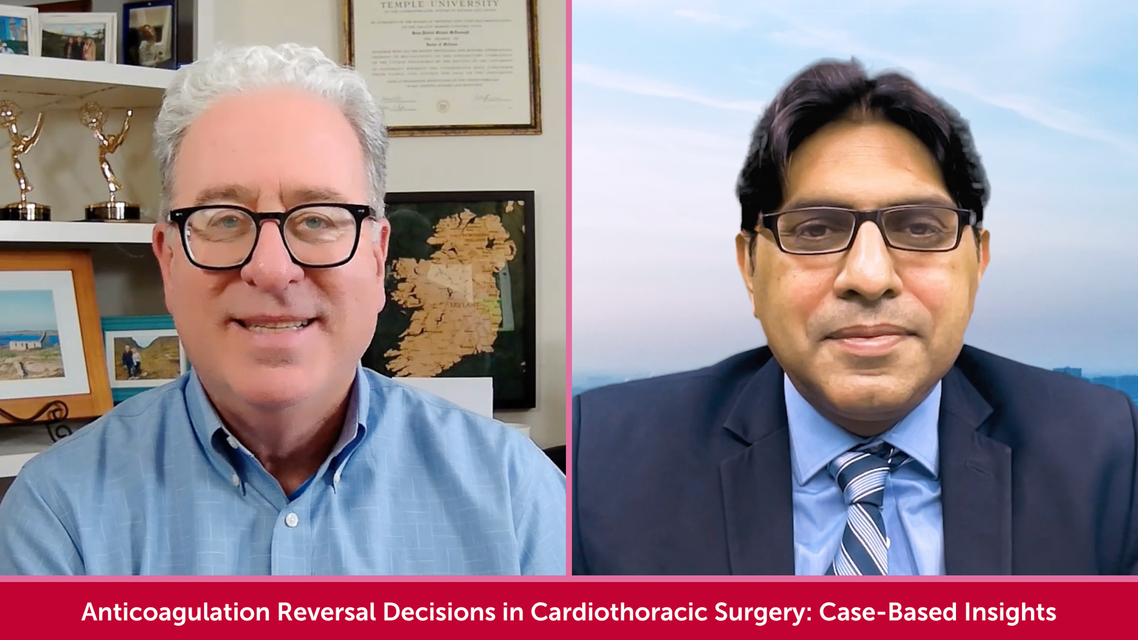
This is Heart Matters on ReachMD. I'm Dr. Brian McDonough, and joining me today for a case-based discussion on anticoagulation reversal decision-making in cardiothoracic surgery is Dr. Akshay Kumar. He's a Clinical Assistant Professor in the Department of Cardiothoracic Surgery at NYU Grossman School of Medicine.
Dr. Kumar, thanks for being here today.
Dr. Kumar:
Such a great pleasure. Thank you so much.
Dr. McDonough:
Well, Dr. Kumar, let's dive right in. Can you walk us through a scenario where an anticoagulated patient developed active bleeding during cardiothoracic surgery and describe how you assessed the situation, communicated with the team, and arrived at a reversal decision?
Dr. Kumar:
You see, Dr. McDonough, excessive intraoperative and postoperative bleeding is a major complication we see in almost 15 percent of our cardiac surgery patients, and it's associated with increased morbidity, mortality, and healthcare resource utilization. Moreover, the overall use of anticoagulation therapy in the US population has tremendously risen over the last decade, given the expanded indications for use and widespread adoption of direct oral anticoagulants.
I remember this one particular patient who presented to us with cardiogenic shock following acute MI and needed to go to the operating room for emergency CABG operation. So you see, in these operations, the patient has to be given systemic heparin to be placed on cardiopulmonary bypass. And then, at the end of the case, we reverse it with protamine, and then I dry up the patient to close his chest. In addition, the patient was already on apixaban preoperatively for chronic atrial fibrillation, and I was cognizant of this fact right from the beginning of the operation when I opened his chest.
One cannot overemphasize here how important it is to have continuous and direct communication with your team of anesthesiologists, perfusionists, and scrub techs about the risk of ongoing bleeding, as well as the need for blood products during hemostasis. So I do a real-time assessment of the operative field in terms of how wet the field looks when I see diffuse bleeding, and then I know in the back of my mind that some reversal agent will be needed at the end of the case.
Once I was sure that all the surgical sites were hemostatic by addressing them with repair sutures or topical hemostatic agents, if there was continuous bleeding going on in the operative field, I would order point-of-care testing. In that case, my institute has TEG, or thromboelastogram.
Here, my choice was to give plasma, as I wanted to give volume. So you see, it's a team-based approach where we have shared decision-making, and the decision is going on throughout the case, relying on sound clinical judgment and laboratory results.
Dr. McDonough:
Now, let's discuss a case where you selected a different reversal strategy. What were the clinical circumstances, and what drove your decision toward the alternative approach?
Dr. Kumar:
Brian, a few months back, I had this LVAD patient who was having repeated admissions from complications of recurrent driveline infections. He was eventually listed for heart transplant, and I was waiting in the hospital for quite some time because he was blood type O. And then one fine evening, we got a heart offer for him as another center declined the donor heart for unforeseen reasons. We were lucky to have this donor heart offer, but time was our enemy. We had to be in the operating room to do this extremely complicated four-time redo sternotomy, crack open his chest, put him on bypass, explant the old heart with the LVAD, and be ready for the new heart. Imagine doing all this in just a few hours.
Our patient was already on warfarin for anticoagulation, so I decided to use four-factor prothrombin complex concentrate for reversal. You see, patients on vitamin K anticoagulants have options to use fresh frozen plasma as well. However, plasma requires larger volume and longer duration for administration. So my choice here was dictated by how soon I needed to achieve reversal and how much volume I could afford to administer to the patient given the time I had in mind.
Dr. McDonough:
Interesting. Now, can you tell us about a time when a patient on anticoagulation required emergent cardiothoracic surgery, but reversal was necessary before they reached the operating room? How did the surgical and anesthesia teams align on the plan under those circumstances?
Dr. Kumar:
So this is, again, a challenging situation, and I remember one of my cases of type A acute aortic dissection. He had cerebral malperfusion syndrome, and he came in with altered mental status. Now, this is truly an emergency in cardiac surgery practice as mortality rises by every hour of delay in taking the patient into the operating room.
So one thing is that what we do in these kinds of cases is both the surgical and the anesthesia team assist the patient in parallel with reversal decisions being made simultaneously in the operating preparation. There is rapid communication between the team members of any known anticoagulation history the patient has and his hemodynamic status and the intended reversal agent we agree upon, so both the teams are prepared to proceed without further delay.
Dr. McDonough:
For those just joining us, this is Heart Matters on ReachMD. I'm Dr. Brian McDonough, and I'm speaking with Dr. Akshay Kumar about real-world decision-making strategies for anticoagulation reversal in cardiothoracic surgery.
If we take a look at another case, Dr. Kumar, I'd like to hear about a time you decided to defer reversal. What clinical factors supported that decision, and what does it illustrate about where that threshold is?
Dr. Kumar:
Once, I had a patient with aneurysms of the aorta whom I had to operate on for ascending aorta and hemiarch replacement. She also had antiphospholipid syndrome due to lupus and was on warfarin for that. And at the end of her surgery, all her suture lines were absolutely hemostatic. The surgical field was dry with no bleeding whatsoever. I realized that there was no indication for giving reversal to her, and it would have been counterintuitive because she had thrombotic risk from lupus.
But mind you, my decision to reverse was rarely static. The operative findings and hemodynamic status keep shifting during the surgery, and the threshold to escalate to active reversal remains part of my ongoing intraoperative assessment.
Dr. McDonough:
As that case evolved, did your decision to defer hold, or did the clinical picture shift in a way that required you to act?
Dr. Kumar:
So my decision to defer reversal in this particular case did not change. Having said that, ultimately, whatever decision you take, you must own your decision. So at times, when my decision for deferral is ultimately vindicated, it reinforces the value of watchful reassessment.
Oftentimes, escalation does become necessary due to changes in the clinical trajectory of the operating case. And so here, real-time continuous communication between the surgery and the anesthesia teams plays a crucial role, as well as the situational awareness to decide whether you want to act or hold.
Dr. McDonough:
Looking back on the cases we've discussed today, how did the various reversal approaches affect time to operative readiness, intraoperative management, and postoperative outcomes for your patients?
Dr. Kumar:
Your understanding, your choice, and the availability of reversal agent, whether plasma or four-factor prothrombin complex concentrate, will determine the time to achieve hemostatic control, thereby influencing operative efficiency and transfusion requirements across a wide range of clinical scenarios.
The surgical indication of the operation, whether it's emergent versus urgent, and the degree of anticoagulation determine how quickly one is able to achieve operative readiness and how the procedure is managed from there. Obviously, in cases where the anticoagulation reversal was deferred for whatever reason, there were higher chances of going back into the operating room for re-exploration for bleeding, and thereby it prolongs the hospital stay of the patient.
Dr. McDonough:
As we wrap up, Dr. Kumar, what key takeaways would you like to share about the clinical impact of delays in anticoagulation reversal on intraoperative management and patient outcomes?
Dr. Kumar:
Absolutely. Brian, I have a few key takeaway points from our discussion today. Firstly, patients on anticoagulation, whenever undergoing any cardiac surgical procedure, need an individualized approach and judicious management. Any delay in hemostatic control, either from agent selection or communication gaps between a team, adds to morbidity by increasing transfusion requirements and prolonging operative time.
Second, always have an institutional protocol. Preoperative or intraoperative communication gaps arising due to incomplete anticoagulation history or absence of institutional reversal protocols directly affect how quickly and confidently a reversal decision is executed.
Third, rule out surgical bleeding. That's a no-brainer. Remember, delaying or underutilizing suboptimal anticoagulation reversal would adversely affect postoperative outcomes by influencing the recovery trajectory and thrombotic risk management.
Dr. McDonough:
With those key takeaways in mind, I want to thank my guest, Dr. Akshay Kumar, for joining me to share these insights and real-world patient cases on anticoagulation reversal in cardiothoracic surgery. Dr. Kumar, it was great having you on the program.
Dr. Kumar:
Thank you again for the opportunity.
Announcer:
This episode of Heart Matters was sponsored by CSL Behring. To access this and other episodes in our series, visit Heart Matters on ReachMD.com, where you can Be Part of the Knowledge. Thanks for listening!